
Can Britain Stay Open to Chinese Cars and Close to Europe?
The UK car industry is caught between rising Chinese competition and closer alignment with EU industrial rules.
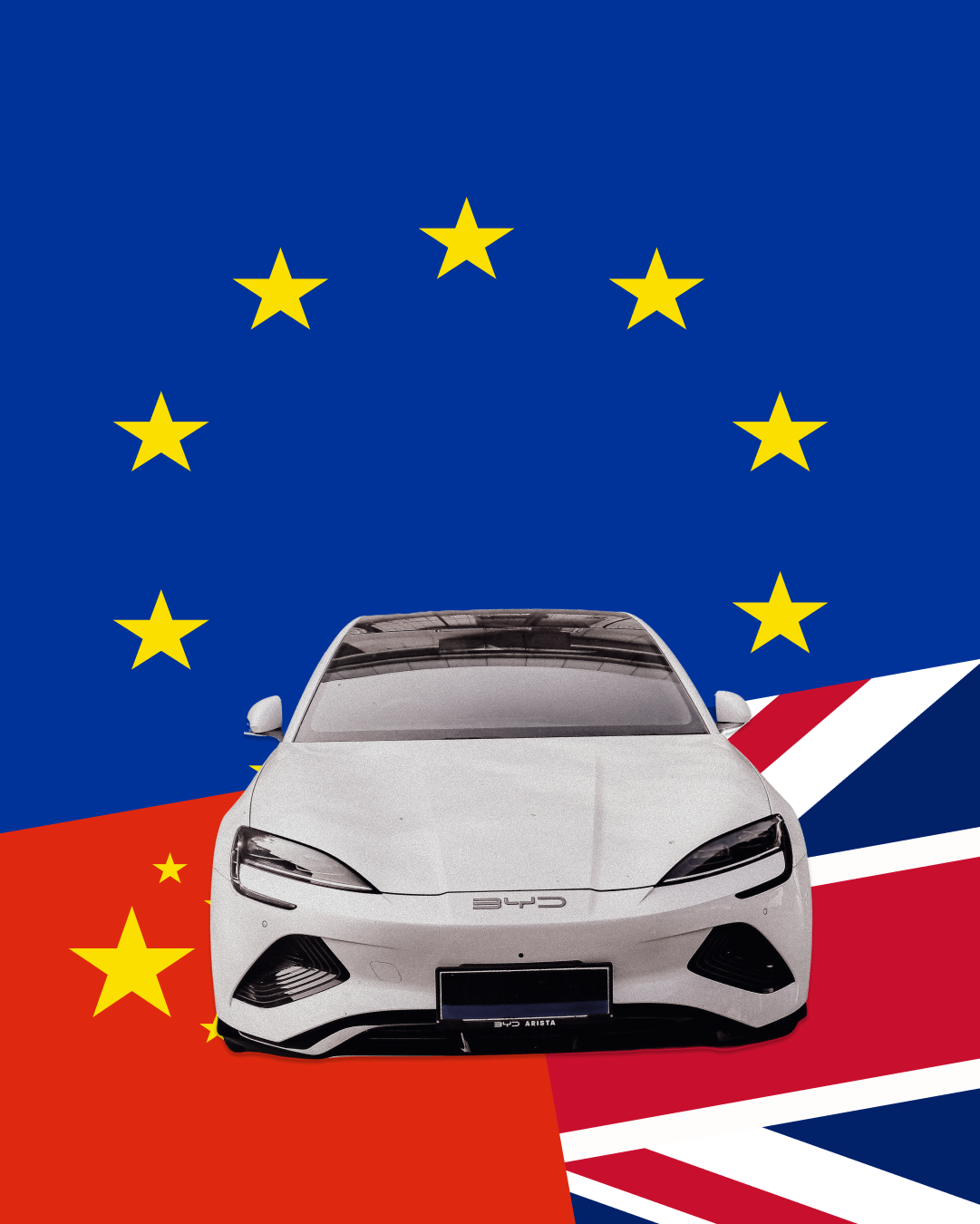
Britain's car market is growing again, but the recovery is exposing an awkward problem. New-car registrations rose by 12% year on year in September 2026, reaching their highest September level since 2017. Electric vehicles were an important part of that growth: registrations of battery-electric cars increased by 36%, while Chinese manufacturers continued to expand their presence in one of Europe's most open major car markets. The stronger sales figures are welcome for the industry. They also make Britain's emerging trade dilemma harder to ignore.
Chinese brands have become an increasingly visible part of the British market. Companies including BYD, Chery and SAIC-owned MG have expanded by offering electric and hybrid vehicles at competitive prices, while newer brands such as Jaecoo have quickly found buyers. Unlike the European Union, Britain has not imposed additional tariffs on Chinese electric vehicles. That has helped preserve consumer choice and made the country an attractive destination for Chinese manufacturers looking for growth outside their weakening domestic market.
For British consumers, the benefits are relatively straightforward. More competition can mean more models, faster technological adoption and greater pressure on established manufacturers to lower prices or improve their products. For policymakers, however, the calculation is more difficult. Britain's automotive industry is not merely a domestic market for cars. It is part of a European manufacturing network that was built over decades and remains closely connected to factories and suppliers across the Channel.
That dependence is substantial. The EU accounted for more than half of British vehicle exports in August, according to industry data cited by Reuters. British manufacturers therefore have an interest not only in selling vehicles domestically but also in preserving favourable access to their largest export market. The EU's proposed “Made in Europe” measures complicate that relationship because they are intended to favour European production and reduce dependence on Chinese supply chains. British manufacturers fear being left outside such arrangements even though their factories remain deeply integrated with the continent.
This creates an uncomfortable trade-off. Aligning more closely with the EU could require Britain to take a tougher position on Chinese vehicle imports. The bloc has already imposed additional duties on Chinese-made electric vehicles after concluding that state subsidies gave producers an unfair advantage. Britain has so far taken a more cautious approach. Tariffs could protect domestic producers from some competition, but they could also raise vehicle prices and make Britain less attractive to Chinese companies considering investment in local factories.
Chinese investment itself complicates the distinction between protecting Europe and restricting China. Chery, for example, has explored manufacturing partnerships in Britain, while Chinese companies are increasingly considering European production as a way to remain competitive despite trade barriers. A Chinese-owned vehicle assembled by British workers with locally sourced components would look rather different economically from an imported vehicle arriving directly from China. Industrial policy therefore has to decide not only where a company's headquarters are located, but what actually counts as domestic or European production.
The tension comes at a difficult time for traditional European carmakers. Manufacturers across the continent face high investment costs associated with electrification, intense Chinese competition and pressure to develop new vehicles more quickly. Some are also exploring businesses outside civilian cars, including defence production, as European governments increase military spending. The diversification illustrates the scale of the industry's challenge, but it is unlikely to remove the underlying pressure from Chinese competitors in the passenger-car market.
Britain's position is particularly unusual because Brexit gave it greater freedom over trade policy while leaving its automotive industry economically tied to Europe. It can choose not to copy EU tariffs, potentially offering consumers cheaper Chinese cars and attracting investment that might otherwise go elsewhere. Yet regulatory independence does not eliminate commercial dependence. If European industrial policies begin favouring companies located firmly inside the bloc's manufacturing ecosystem, Britain's theoretical freedom may carry increasingly tangible costs.
The September sales figures capture this paradox. Britain is enjoying one of its strongest car markets in years just as the competitive structure beneath it is changing. Battery-electric vehicles accounted for 28.3% of registrations in September, according to Reuters, while Chinese brands were becoming increasingly prominent among popular models. Yet stronger consumer demand does not necessarily translate into stronger domestic manufacturing. A country can sell more cars while producing fewer of the vehicles that its consumers buy.
There is therefore no simple choice between an open market and industrial protection. Restricting Chinese imports could support some European manufacturers while making the transition to electric vehicles more expensive for consumers. Keeping the market relatively open may lower prices and attract Chinese capital, but it could increase pressure on domestic manufacturers and complicate Britain's relationship with its largest automotive export market.
Britain's car dilemma is ultimately a question of what kind of automotive industry it wants to retain. Consumer interests, manufacturing employment, foreign investment and access to European markets do not necessarily point in the same direction. The challenge is not merely choosing between China and Europe. It is deciding how much economic independence Britain can exercise when its factories, customers and competitors increasingly belong to different parts of the global car industry.